
May 4, 2026
OrchidE 2025.1.2
OrchidE 2025.1.2 now supports ‘full qualified role name’ (FQRN) in OrchidE’s structure view for Ansible, inventory host entries with patterns, e.g., ‘server[1:2]’, and improves the ‘Find Usages’ action.
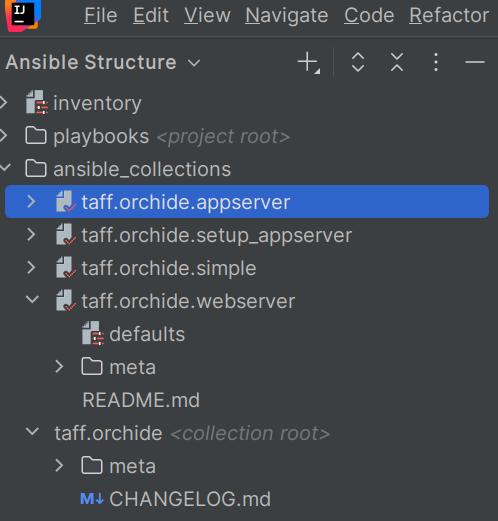
Full qualified role name support
FQRNs are now displayed in the structure view with their full names (namespace + name)
Support for inventory hostname patterns
Hostname patterns (e.g., server[1:2]) are now supported in code completion and navigation.
Improved ‘Find Usages’ action
The Find Usages action has been expanded for Jinja 2 references and variables. In roles, ‘Find Usages’ now finds definitions in role argument-specs and defaults files, as well as usage in Jinja 2 templates and declarations in inventory group/host variable files.
Changes
- New: A new inspection warns if a role is not being used by any playbook when “Use only current role for variable lookup” is enabled.
- Change: Support for new file / new Ansible file action has been improved in the Ansible structure view.
- Bugfix: In certain circumstances, the quick documentation did not show the attributes of a module’s return value.
- Bugfix: Host name definitions in YAML inventory files are ignored when the “Use only current role for variable lookup” option is active.
- Bugfix: Structure view: references are still shown as valid after a role folder has been deleted.
- Bugfix: Several role-related features, such as ‘goto role’ and code completion do not work for roles with only a tasks file.
- Bugfix: Custom schema validation for JSON files reports error when 0 and 1 are used as integer values (they were interpreted as boolean values).
Deprecation
- Support for IntelliJ platform 2024.2 is deprecated and will end with the launch of the EAP for IntelliJ version 2026.2.
- Support for the OrchidE builder format V1 is deprecated.